The World
Global Container System Jams When Australia's Ports Bottleneck Trade
Twenty-foot boxes move 90 per cent of Australia's trade. When the global container network jams, everything from your groceries to your car slows down.
The World
Twenty-foot boxes move 90 per cent of Australia's trade. When the global container network jams, everything from your groceries to your car slows down.
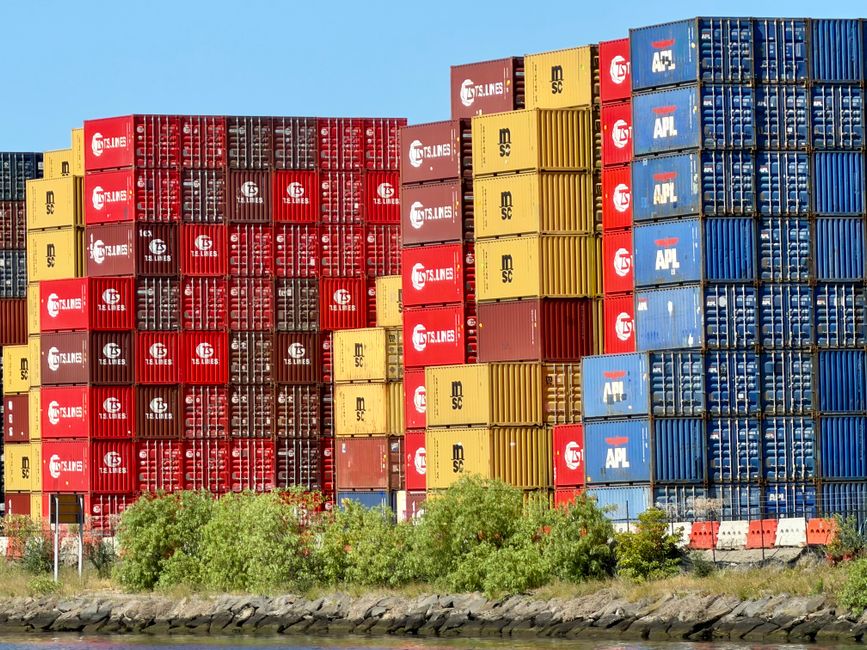
Every day, roughly 40 million shipping containers cross the world's oceans. Most are 20 or 40 feet long, stacked like Lego, and carry everything Australia exports or imports: iron ore, grain, cars, electronics, food, clothing. When a container leaves a port in Western Australia bound for Rotterdam, it enters a system so interconnected that a delay in Shanghai ripples through your local supermarket within weeks. Understanding how this system works explains why Australia's geography makes it both powerful and vulnerable.
Before the 1950s, ships were loaded and unloaded by hand, one crate at a time. It took weeks to turn a ship around. A standardised metal box changed everything. Today, a container can be loaded onto a truck in Sydney, transferred to a ship, unloaded at a distant port, and moved onto a train or lorry without ever being opened. That speed and reliability created the modern global supply chain. Ports race to handle containers faster and in higher volumes because every hour a ship sits idle costs money. Australia's ports in Brisbane, Melbourne, Sydney and Fremantle are major nodes in this system, handling imports and exports worth hundreds of billions of dollars a year.
The global container system works only if boxes move continuously. A ship needs containers to be waiting when it arrives, and containers need ships ready to leave. That delicate balance breaks down regularly. When a port congests, empty containers pile up in the wrong place. When demand surges, there are not enough containers on the route you need. If a major port closes for storms or labour strikes, the flow stops worldwide. Australia is particularly exposed: it is geographically distant from major trading partners in Asia and Europe, so containers must spend weeks in transit. Any delay multiplies across the entire chain.
Ship operators manage this by moving containers across routes based on demand. A container that brings goods into Australia often leaves empty or half-filled because Australia exports fewer manufactured goods than it imports. That imbalance means shipping costs to Australia rise, adding to the price of goods on Australian shelves. When global trade shocks occur, like the pandemic or port strikes, Australian importers feel the impact acutely because alternative routes are far away.
Australia's major ports compete to move more containers faster. They invest in bigger cranes, deeper berths for larger ships, and automated systems. But ports are physical spaces with hard limits. A port can only handle so many ship visits per week, and only ships of a certain size can dock at certain terminals. Container stacks take up enormous land. As container traffic has grown, Australia's ports have become more congested, not less. Fremantle, Melbourne and Brisbane all operate near capacity during peak seasons. Sydney Harbour's geography limits how big ships can be. These constraints mean that when global container demand peaks, Australian importers wait longer and pay more.
Australians experience the container system as delays and prices. When a container ship is stuck waiting to unload in Brisbane, goods bound for stores nationwide are stuck too. When global shipping rates spike, the cost is embedded in your groceries, furniture and clothes before they reach a shelf. Port congestion also affects Australia's exports. Iron ore, coal and agricultural products sit in yards waiting for ships, tying up money and storage space. As Australia aims to export more renewable energy products and rare earth processing, the capacity of its ports becomes a hard limit on economic growth. Investing in port infrastructure is investing in Australia's ability to trade with the world quickly and cheaply.
The global container system is the invisible circulatory system of world trade. Australia depends on it absolutely, but has little control over it. Local port congestion reflects global imbalances in container supply and demand. As global trade patterns shift and extreme weather becomes more common, the reliability of this system is not guaranteed. For Australia, that means the cost and speed of moving goods will remain volatile unless ports invest heavily in capacity, and unless the global container network itself becomes more resilient to shocks.
This article was compiled by AI and screened before publishing. See our editorial standards.
Spread the word
More from The World
The Daily Network — local news across Australia